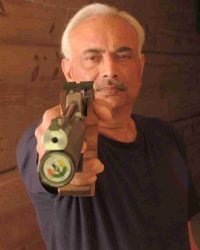



Most shooters want better scores, so naturally, they shoot more pellets.
But one of the strange realities of 10m air pistol shooting is that some of the biggest improvements occur when no pellets are fired at all. That is the power of dry firing.
For beginners, dry firing often feels boring because there is no recoil, no score, and no visible result.
Yet elite shooters understand something important: good shooting is not built during recoil. It is built before the shot breaks. Dry firing trains exactly that part of the process.
Dry firing simply means practicing the complete shot process without firing a live pellet.
The shooter still raises the pistol, aligns the sights, applies trigger pressure, follows through, and observes the movement.
The only thing missing is the pellet itself. Ironically, that missing pellet is what makes the practice so valuable because it removes distraction and allows complete attention to shift toward technique.
In live shooting, the brain quickly becomes obsessed with results.
After every shot, the mind jumps toward score, grouping, and shot placement. Dry firing removes that mental noise.
Instead of chasing outcomes, the shooter begins studying the real foundations of performance: trigger movement, sight stability, grip pressure, hold quality, and follow-through. This creates much faster technical learning because awareness becomes sharper.
Another reason dry firing works so effectively is repetition volume.
A shooter may fire sixty live shots during a training session, but in the same amount of time, they can perform two hundred or even three hundred high-quality dry fire repetitions.
Shooting is ultimately a motor skill, and motor skills improve through correct repetition. The brain learns consistency by repeating the same movement pattern again and again without interruption.
The greatest benefit of dry firing is usually seen in trigger control.
Most shots are lost not because of poor aiming, but because the trigger disturbs the sights at the final moment.
During dry firing, this becomes very obvious. The shooter can clearly observe sight movement, anticipation, jerking, hesitation, or collapse immediately after the click. Live firing often hides these mistakes behind recoil and score. Dry firing exposes them directly.
However, dry firing only works when it is practiced with seriousness and attention.
Many shooters perform it casually while thinking about other things, turning it into empty repetition. That defeats the purpose completely.
Every dry shot should be treated like a competition shot, with full awareness from the raise to the follow-through. Even ten highly focused repetitions are more valuable than a hundred careless ones.
A good dry firing session does not need to be complicated.
The shooter raises the pistol naturally, settles into the aiming area, focuses sharply on the front sight, applies steady trigger pressure, observes the sights as the click occurs, and maintains follow-through for a few seconds afterward.
That final part matters more than most shooters realize because many mentally abandon the shot the instant the trigger breaks. Dry firing teaches patience and observation beyond the click.
Live firing shows the result of a shot. Dry firing reveals the cause.
Shooters who understand causes improve far faster than shooters who simply chase scores. Sometimes the fastest way to raise your score is to stop firing pellets for a while and learn what is actually happening inside the shot process.