


Written by Hemant Jadhav

Table of Content
Shooter’s Say-so
In ISSF 10m Air Pistol, shooters often focus heavily on trigger control, sight alignment, and breathing. These are essential skills, but they all depend on a deeper and more fundamental element: shooting stability.
Without stability, every other technique becomes difficult to execute. When the body struggles to support the pistol, the sights wander unpredictably and the shooter begins to fight the gun instead of guiding it. The result is hesitation, inconsistent trigger release, and lower scores.
Stability is therefore the true platform on which consistent shooting performance is built.
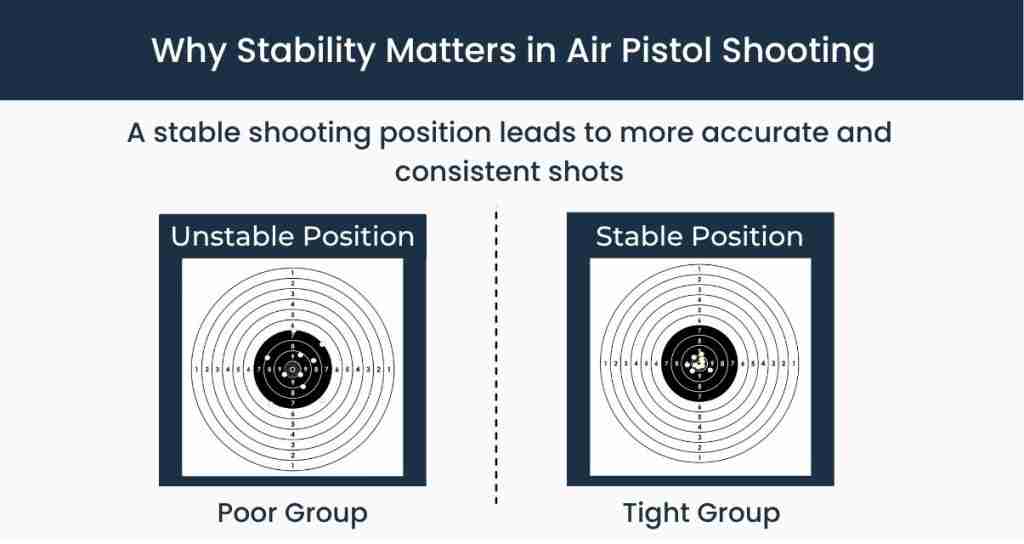
A common misconception is that stability means holding the pistol perfectly still. In reality, no shooter, no matter how experienced, can completely eliminate movement.
Every shooter experiences a natural oscillation of the sights known as the arc of movement.
The goal is not to remove movement entirely but to control it within a small and predictable range. When stability improves, three important changes occur:
These changes have a direct effect on shot quality.
Many shooters assume that poor shots are caused by bad trigger control. In many cases, however, instability in the shooting position is the real source of the problem.
When the body struggles to maintain balance, muscles begin to compensate. This muscular effort introduces tremors and fatigue. As fatigue increases, sight movement becomes more erratic.
The mind then reacts to this instability by becoming cautious or anxious.
The shooter begins to delay the shot, waiting for the “perfect moment.” Eventually the shot is forced, or it breaks too late.
What began as a physical issue quickly becomes a mental one.
A stable position does more than improve physical control—it also strengthens confidence.
When the body feels balanced and relaxed, the shooter trusts the shot process. The trigger can be pressed smoothly without hesitation because the sights are moving in a predictable pattern.
This sense of trust is critical during competition.
Many shooters believe pressure comes from the importance of the match. In reality, pressure often increases when the shooter feels uncertain about their ability to execute the shot.
Stability removes much of that uncertainty.
For shooters who want long-term improvement in ISSF 10m Air Pistol, stability must become a training priority.
Before refining advanced trigger techniques or mental strategies, the shooter must build a position that is:
• Balanced
• Relaxed
• Repeatable
Once that foundation is established, every other part of the shooting process becomes easier to develop.
In precision shooting, a stable body allows a calm mind and a confident trigger release.
Shooter’s Say-so
Author
Hemant Jadhav is the founder of Foresight Shooting and an ISSF-certified 10 meter air pistol coach, specializing in performance under pressure and precision shooting systems.
Through his work, he focuses on helping shooters build consistency, stability, and mental control, turning technical skills into repeatable high-performance outcomes.
He is deeply committed to the sport and spends extensive time training, analyzing performance patterns, and refining methods that improve accuracy and confidence in competition.
Outside of coaching, he values time with his family and often retreats to his farmhouse, where he disconnects, reflects, and resets.
Keep Learning
Mechanical vs Electronic Trigger for 10 M Air Pistol: Which Is Better?
If you are planning to buy a 10 m air pistol, one of the biggest decisions you will face is choosing between a mechanical trigger...
Read More →
10m Air Pistol Shooting Position: Why Comfort Improves Accuracy and Performance
Introduction In 10m air pistol shooting, every point matters. While shooters often focus on sight alignment, trigger control, and mental preparation, one of the most...
Read More →
10m Air Pistol Dry Firing: Improve Your Score Faster
Most shooters want better scores, so naturally, they shoot more pellets. But one of the strange realities of 10m air pistol shooting is that some...
Read More →
Why Stability Is the Foundation of Success in Air Pistol Shooting
In ISSF 10m Air Pistol, shooters often focus heavily on trigger control, sight alignment, and breathing. These are essential skills, but they all depend on...
Read More →